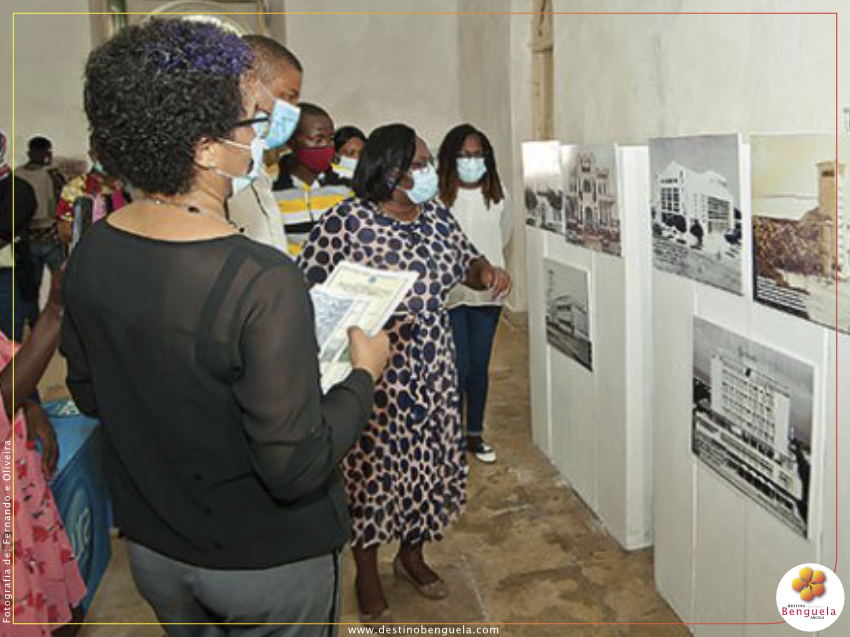
The 30 images compiled by the museum portray the chronology of the tangible and intangible heritage of the city of Benguela, in a trajectory that goes back to the arrival of Cerveira Pereira, a Portuguese administrator who held the position as captain-general in the captaincy-general of Angola twice, the first between 1603 and 1607 and the second between 1615 and 1617, who is credited with founding the city, until the 20th century.
According to Maria Helena Benjamim, the photographic exhibition aims to expand knowledge about the colonization process and the people who lived in Benguela, the oldest city in Angola, after Luanda and establishes a bridge between the 404 years of the city of Benguela celebrated on the 17th of May and the international day of museology celebrated on the 18th of May, and will continue to give visibility to the history of Benguela through the various places that embody the past of the quadricentennial city.
Among the items on display, the notable building called "Palácio do Governador" stands out, a characteristic work of residential architecture from the 17th and 18th centuries, classified as a property of public interest on February 8, 1950. The first news about the location of this residence dates from 1791. The exhibition also highlights the Church of Nossa Senhora do Pópulo, a century-old infrastructure of the Catholic Church, with its own characteristics, being a cultural heritage of national interest with a very rich history, whose preservation is recommended for the knowledge of future generations.
The director of MNAB, Maria Helena Benjamim, said that the catalog was produced to complement the images on display and explains the before and after of the scenes portrayed, for example, "what was the governor's palace in the 18th century and what it is today In the 21st century, we managed to compile 30 images that may not seem like anything to many, but for us they represent a good example”, he emphasized.
Holistic view
The head of MNAB said that the institution intends to expand and incorporate knowledge of the reality of socio-anthropology in Benguela into other sciences such as Sociology and History, until we have a broader idea of the past that is still alive in the present.
"As director of the museum, what moved me most was hearing about the fortress, someone, through social media, revealed something that is here right in front of our eyes, in the current space between the Church of Nossa Senhora do Pópulo and the criminal investigation services building, a sign that history is not erased”, he explained.
Regarding the role of the museum in valuing and disseminating History, the director of the institution, Maria Helena Benjamim, informed that from now on the museum will expand the scope of dissemination of information particularly to students who have the subject on their "curriculum" of History.
"Our plan also incorporates the creation of a collection to expand the dissemination of information and knowledge. Whenever someone appears who wants to add a little more knowledge to their knowledge, the catalog will serve as a guide, mainly for the different tourists who visit Benguela, lovers of our history and culture”, he explained.
The MNAB project also aims to reach history students, "what specifically do they deal with about the history that has to do with the city of Benguela? So, from Now we're going to be the source.
The project will include the Instituto Jean Piaget de Benguela, the Instituto Superior Politécnico de Benguela, which have an architecture course in their portfolios, a team that aims to be multidisciplinary to work on a plural project. The project, initially launched in 2000, with the social sciences department of the Instituto Superior de Ciências de Educação de Benguela (ISCED), which teaches archeology in the History course, was then resumed in 2017 and annually sends students to the museum for classes. of archaeological research practices in the field, which has already resulted in twelve final course assignments in the History specialty where students addressed topics that have to do with the archeology museum.
"For this year, given the restrictions imposed by Covid-19, exceptionally the museum will not carry out the practices on the ground itself, but we will do them on the museum's premises", he said.
On the other hand, MNAB receives Prof. Doctor Manuel Gutieres, French specialist from the Sorbonne University in Paris, as a teacher on the basis of the protocol between the University of Paris and ISCED.
Rehabilitation is still a mirage
With an area of 8,000 square meters, the imposing building built in the 17th-18th centuries on the basis of limestone blocks, has been waiting for years for works on all of its structures, with several cracks visible in the walls, clearings on the roof, and the require new doors and windows, as well as equipment consistent with the current dynamics of scientific and cultural intervention.
According to the director of MNAB, the idea of recovering the museum has been raised for practically 40 years, "but so far it has not materialized, "it's sad, it's something we talk about repeatedly, but nothing happens”, lamented.
The National Archeology Museum was created in the same building where it remains, to this day, under the direction of its founder, the conservative archaeologist Luís Pais Pinto and Maria Helena Benjamim recalls that the first idea for the building's rehabilitation was designed with a ruler on two sheets of cardboard. “We knew what we wanted, we outlined the various departments of archeology and anthropology, we focused on everything from prehistory to the present day,” she recalled.
The head of MNAB recalls that, in February 2019, provincial governor Rui Falcão made the consignment notice for the work with a guarantee of execution within nine months, but then the pandemic emerged and everything remains unknown, not even the Ministry of Culture Neither the Provincial Government of Benguela did anything to change the current situation.
"The National Museum of Archeology in Benguela forged cadres of recognized technical capacity, with emphasis on Rosa da Cruz e Silva and the current Secretary of State and former Minister of Culture, Maria da Piedade. It is sad that we continue to look at this, every day that When this happens, the structure is profoundly degraded. How long will we wait? Is this possible?” he asked.
Source: Angop
 English
 Português